


Dji Osmo Pocket 4 vs Pocket 4P Review

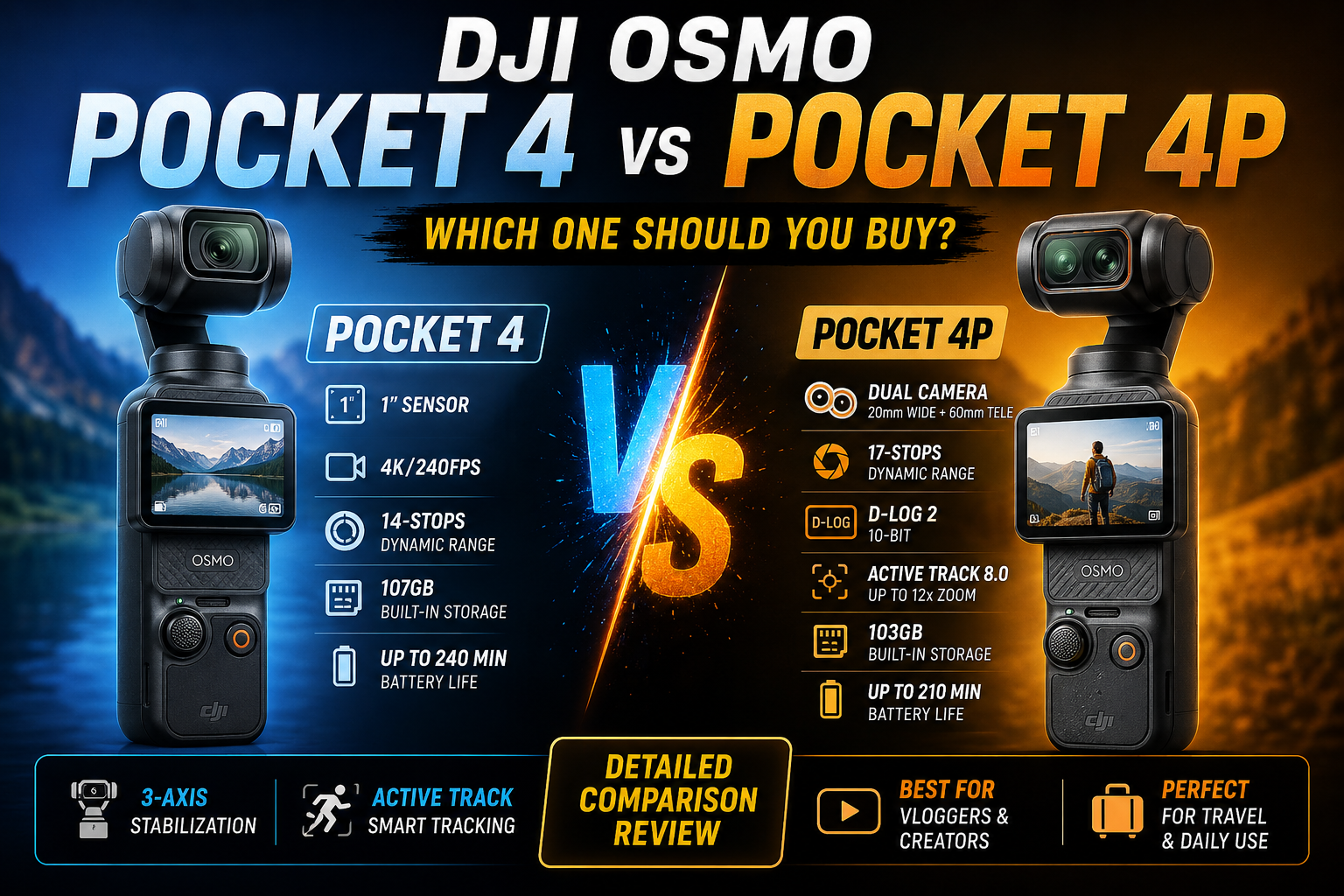
DJI Osmo Pocket 4 vs Pocket 4P: Which Pocket Gimbal Camera Should You Buy?
DJI’s Osmo Pocket line has been the default recommendation for anyone who wants big-camera stabilization in a phone-sized body, and the fourth generation raises the stakes by splitting into two models instead of one. The standard Osmo Pocket 4 launched in April 2026 with a single 1-inch sensor, while the Osmo Pocket 4P followed a few months later with a second, telephoto lens bolted on. On paper they look like siblings; in practice, the gap between them comes down to a handful of decisions that matter a lot depending on what you shoot.
Here’s how they actually compare.
DJI Osmo Pocket 4 vs Pocket 4P: Quick Comparison
| Feature | DJI Osmo Pocket 4 | DJI Osmo Pocket 4P |
|---|---|---|
| Camera System | Single Camera | Dual Camera |
| Main Sensor | 1-inch CMOS | 1-inch CMOS |
| Secondary Camera | No | 1/1.28-inch CMOS |
| Main Lens | 20mm f/2.0 | 20mm f/2.0 |
| Telephoto Lens | No | 60mm f/1.8 |
| Dynamic Range | Up to 14 Stops | Up to 17 Stops |
| Color Profile | 10-bit D-Log | 10-bit D-Log 2 |
| Maximum Video | 4K/240fps | 4K/240fps Wide / 4K/200fps Tele |
| Stabilization | 3-Axis Gimbal | 3-Axis Gimbal |
| Tracking | ActiveTrack | ActiveTrack 8.0 |
| Built-in Storage | 107GB | 103GB |
| Screen | 2-inch OLED | 2-inch OLED |
| Operating Time | Up to 240 Minutes | Up to 210 Minutes |
| Weight | Approx. 190.5g | Approx. 230g |
Quick Take
- Get the Pocket 4 if you want the lightest, simplest version of this camera and don’t need reach beyond a 2x digital crop.
- Get the Pocket 4P if you regularly want to get closer to a subject without moving, or you shoot in tricky light and want the extra dynamic range headroom.
- Neither camera is officially sold in the US yet, so pricing and availability outside China and other approved markets still runs through importers.
Design and Handling
Both cameras keep the format that made the Pocket 3 a hit: a 2-inch rotating touchscreen, a 3-axis mechanical gimbal, and a body small enough to disappear in a jacket pocket. The clip-on extension grip and mini tripod legs are shared across both models, so existing Pocket 3 accessories should carry over.
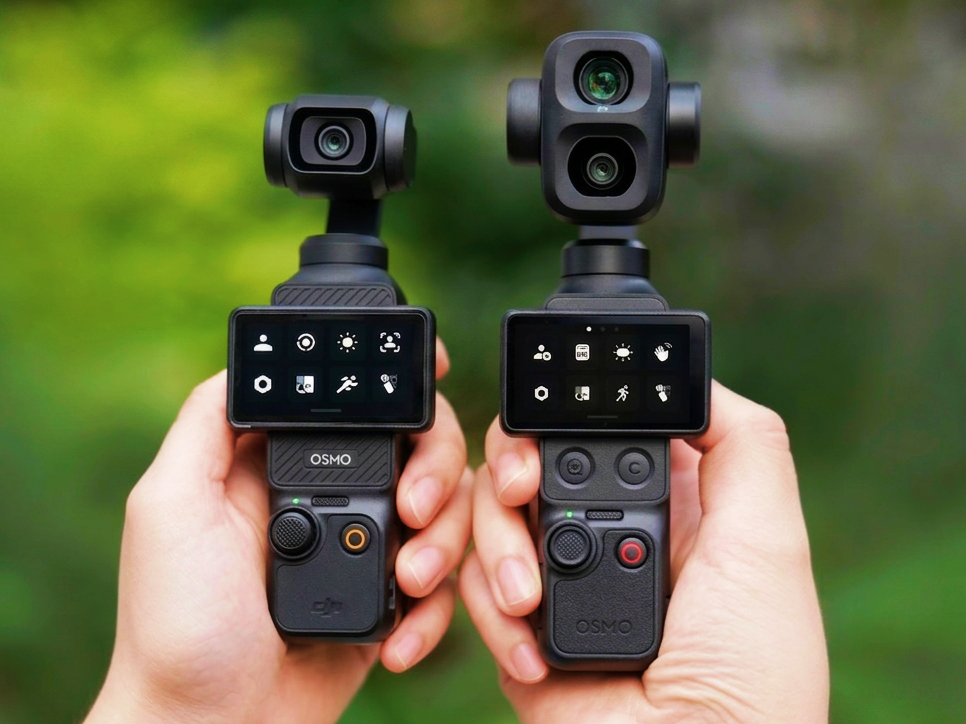
The obvious physical difference is the second lens on the 4P, which makes the camera noticeably taller and more top-heavy in hand. It’s still pocketable, but it’s a visibly bigger device than the standard Pocket 4, and that extra hardware adds real weight — enough that the standard Pocket 4 is described as significantly lighter in side-by-side testing. Neither camera adds any weather sealing over its predecessor, so both still call for some caution shooting in rain or dust.
Cameras, Zoom, and Image Quality
This is where the two models actually diverge.
The Pocket 4 sticks with one 1-inch, 37MP sensor and a single wide lens. Its oversized sensor allows a clean digital crop to about 2x before the image starts to soften — fine for framing adjustments, not a real zoom.
The Pocket 4P adds a second lens: a wide-angle 1x paired with a longer telephoto, giving you a dedicated zoom range that DJI lets you jump between with a physical button (1x, 3x, and a further digital push to 6x), or ease into more gradually by holding the button down or using the joystick. Reviewers note a slight visual jump when the camera switches between lenses mid-zoom, so it behaves more like carrying two or three fixed prime lenses than a smooth optical zoom — useful for reframing between shots, less ideal for a slow push-in during a single take.
On dynamic range, the Pocket 4P pulls ahead thanks to its access to DJI’s newer D-Log 2 color profile, rated around 17 stops versus roughly 14 stops on the standard Pocket 4’s D-Log mode. In everyday, well-lit footage the difference is subtle since both cameras tone-map their output, but it becomes more visible in high-contrast or low-light scenes, where the 4P has more room to recover highlights and shadows in post.
Storage, Audio, and Battery
Both cameras include built-in storage plus a microSD slot, USB 3.1 connectivity rated for offload speeds up to 800MB/s, and DJI’s four-channel OsmoAudio system, which can record two channels of wireless mic audio (compatible with the DJI Mic 2, Mic Mini, or Mic 3) alongside two internal channels. Slightly oddly, the Pocket 4P actually ships with a little less built-in storage than the standard model — 103GB versus 107GB — presumably to make room for the second lens assembly.
Battery life favors the simpler camera: the standard Pocket 4 is rated for a longer runtime than the 4P, whose extra sensor and processing draw more power. Fast-charging support on the 4P is a bright spot in the field, though — paired with a higher-wattage charger, it’s possible to keep shooting for well over an hour while plugged in without overheating.
Price
Pricing has moved around as both cameras rolled out, but the shape of it is consistent: the Pocket 4P costs more than the standard Pocket 4, with reviewers pricing the gap at roughly $120–150 depending on region and bundle. The standard Pocket 4 starts in the $499–549 range with a pricier Creator Combo (adding a DJI Mic 3, fill light, and battery handle) landing closer to $650–800. The Pocket 4P sits above that, with global estimates clustering around $650–770 for the base kit.
Worth noting: as of this writing, neither camera is officially sold in the United States, so US buyers are generally importing through resellers, which adds cost and removes any official warranty support.
Spec Snapshot
| Osmo Pocket 4 | Osmo Pocket 4P | |
|---|---|---|
| Lenses | Single wide, 1-inch sensor | Dual: wide + telephoto, 1-inch sensors |
| Zoom | ~2x digital crop | 1x / 3x optical-style switching, up to ~6x digital push |
| Dynamic range | ~14 stops (D-Log) | ~17 stops (D-Log 2) |
| Built-in storage | 107GB | 103GB |
| Battery life | Longer | Shorter (but supports faster charging) |
| Weight | Lighter | Heavier |
| Starting price | ~$499–549 | ~$650–770 |
Verdict
The Pocket 4P is the more capable camera on paper, and if reach and dynamic range matter to your work — wildlife, events, run-and-gun documentary shooting — the second lens genuinely changes what’s possible without carrying extra gear. But the standard Pocket 4 isn’t a compromise pick; it’s lighter, cheaper, has more built-in storage, and covers what most vloggers, travelers, and social content creators actually need. Unless you already know you want that zoom range, the Pocket 4 is the easier camera to recommend, with the 4P reserved for shooters who’d specifically miss having it.
Pricing, availability, and specs above reflect early 2026 reviews and regional launches, and may shift as both cameras roll out to more markets.